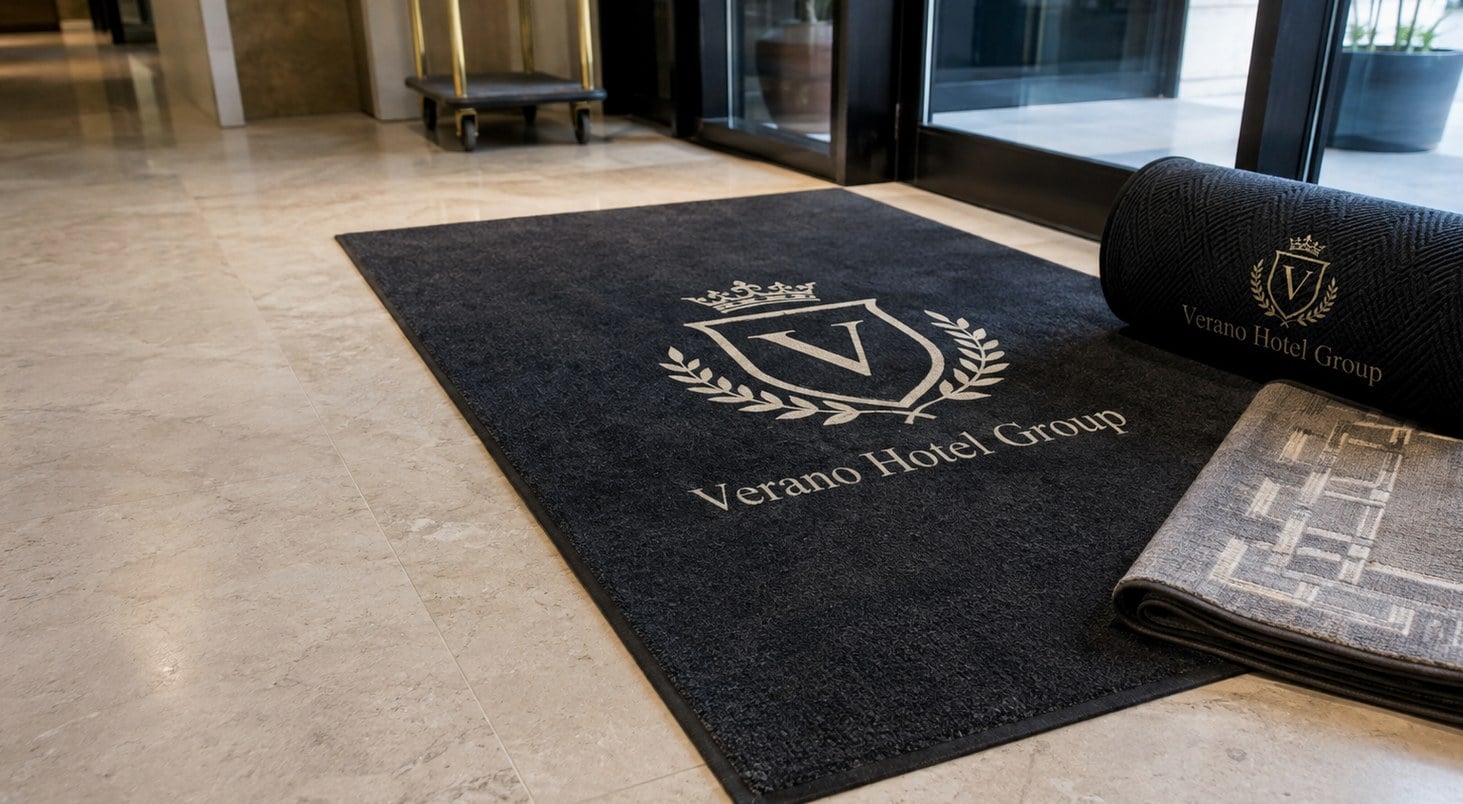
Great custom rugs start with vector logo files, official brand colors and a layout planned for how people see a floor: from standing height, while walking in. Get Custom Rugs turns that artwork into a free mockup within 24 hours, adjusts detail for printed or tufted construction and makes nothing until you approve the design.
- Vector files (AI, EPS, SVG or vector PDF) give the cleanest edges on rugs.
- Printed rugs carry photos and gradients; tufted rugs suit bold, solid-color logos.
- Free mockup within 24 hours, with unlimited free revisions.
- Minimum order is 12, and standard turnaround is about 2 weeks after approval.
What logo file should you send for custom rugs?
The best logo file for custom rugs is vector artwork: an AI, EPS, SVG or a PDF that was exported from a design program rather than scanned. Vector files hold clean edges at any size, which matters on rugs because a logo that looks crisp on a business card gets scaled up many times to cover an entrance mat or a runner.
If vector art is not on hand, send the largest, sharpest version you have and tell Get Custom Rugs what it is. The design team can often rebuild a simple mark from a good raster file, and the free mockup within 24 hours shows you exactly how the rebuilt artwork will sit on the rug before anything is made.
- Best: the original vector file from whoever designed the logo, with fonts outlined.
- Workable: a large PNG with a transparent background, or a high-quality PDF.
- Risky: a logo copied from a website, an email signature or a social media avatar.
- Helpful extras: your brand guide, official color references and any rules about clear space or minimum size.
Ask your marketing team or original designer for the master files before you request a quote. That single email usually saves a full round of revisions.
How does the decoration method change what your artwork can do?
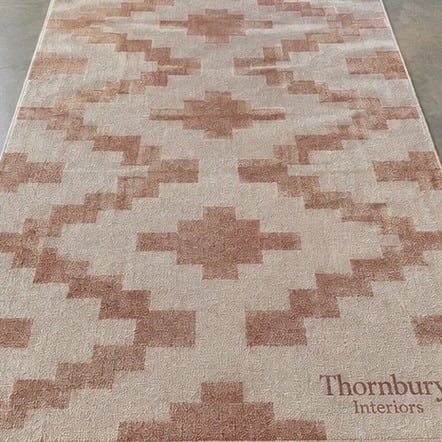
The decoration method decides how much detail your custom rugs can carry. Dye-sublimated printed rugs reproduce photos, gradients and fine lines because ink is transferred into the fibers, while tufted rugs build the design from yarn, so they suit bold shapes, solid color areas and larger lettering. Choosing the method first makes the artwork decisions easier.
Printed construction is common on printed event rugs and many logo entrance mats, where a full-color logo, a sponsor wall or a photo backdrop has to read clearly. Tufted construction gives a rich, dimensional look on lobby and custom area rugs, but each color becomes its own yarn, so simpler artwork tends to look best.
| Artwork element | Printed (dye sublimation) | Tufted |
|---|---|---|
| Photos and gradients | Reproduces well | Usually simplified into solid color bands |
| Small text and thin outlines | Holds up when sized sensibly | Needs to be enlarged or thickened |
| Solid brand colors | Matched by ink | Matched by yarn, with a rich pile texture |
| Best fit | Events, booths, detailed logos | Lobbies, offices, simple bold marks |
If you are unsure, send the artwork and describe where the rug will go. Get Custom Rugs will recommend a method and show it on the mockup.
How do you get brand colors right on a rug?
Brand colors on custom rugs come out most accurately when you supply official color references, such as Pantone codes from your brand guide, rather than asking the team to sample colors from a screen. Screens, printers and fibers all render color differently, so a named reference gives everyone the same target.
Fiber and pile also affect how a color reads. A deep pile catches light and shadow, so dark shades can look slightly richer on the floor than on a flat sheet of paper. Contrast matters more on rugs than in print: a navy logo on a charcoal background may be on-brand, but it can disappear once the mat has a few days of foot traffic on it.
- Pick a background color that contrasts clearly with the logo, and test it on the mockup.
- Limit tufted designs to the colors the logo truly needs; fewer colors usually look sharper.
- Consider a darker field for entrance mats, which hides soil better than a white or pale background.
- Keep the same color references for reorders so later batches match the first.
Fading and outdoor exposure are material questions as well as artwork questions, so the nylon vs. polyester comparison is worth reading if the rug will see sun or salt.
Where should the logo sit on an entrance mat or runner?
The logo on custom rugs should sit where people actually look: centered and facing the person walking in on an entrance mat, and repeated or placed toward the approach end on a runner. A rug is read from a standing height and while moving, so placement, orientation and margins matter as much as the logo itself.
Orientation is the most common oversight. Decide which way visitors approach the door and make sure the logo reads right side up for them, not for the person leaving. On custom runner rugs, a single small logo in the middle of a long corridor can be lost, so many buyers repeat the mark, add a directional message or run a border stripe along the length.
- Mark which edge faces the door or the main approach.
- Leave generous clear space around the logo so the border never crowds it.
- Keep text away from the edges, where wear and traffic are heaviest.
- Note any furniture, check-in desks or doors that will cover part of the rug.
Share a quick photo or sketch of the space with your request. Get Custom Rugs places the artwork to suit the actual floor, then shows it on the mockup for approval.
Can one order of custom rugs carry different artwork?
Yes, one order of custom rugs can carry several artwork versions, such as a different location name on each entrance mat, a sponsor version for an event or a seasonal message alongside the main logo. Get Custom Rugs keeps the minimum at 12 pieces for the order, and each version gets its own mockup so every file is checked before production.
Versioning works best when the layout is shared and only one element changes. A franchise might keep the logo, colors and border identical and change only the city name, which keeps the brand consistent from door to door. For a trade show, the booth rug might carry the full logo while smaller anti-fatigue logo mats behind the demo counter carry a simpler mark.
- Send a list that pairs each version with its size, quantity and location.
- Proofread names, addresses and taglines in the list before you send it.
- Name a single person to approve every version so feedback does not conflict.
Clear version lists make the approval stage fast, and they make reorders simple because every file is already labeled.
What artwork mistakes cause problems on a first rug order?
The most common artwork mistakes on custom rugs are low-resolution logos, text that is too small to read from standing height, low contrast between logo and background and designs oriented the wrong way for the door. Every one of these is easy to catch at the mockup stage if you review the proof as a visitor would see the rug, not as a file on a monitor.
- Too much copy: a rug is glanced at, not read. Keep to a logo and a short message.
- Fine detail on tufted rugs: hairline strokes and tiny lettering need to be thickened or dropped.
- Old logos: confirm the file is the current version, especially after a rebrand.
- Ignoring the floor: a mat partly under a door swing or a desk loses part of its design.
- Skipping the outdoor question: outdoor scraper mats work best with bold, simple marks, because the surface is built to scrape soil rather than show detail.
Revisions are free and unlimited, and you pay nothing until you approve the design, so there is no reason to approve a proof you are unsure about. Ask for a change and Get Custom Rugs updates the mockup.
How does the proof and approval process work?
Get Custom Rugs sends a free mockup of your custom rugs within 24 hours of receiving your artwork and order details, and nothing goes into production until you approve it. The mockup shows the rug size, shape, colors, logo placement and any text, so it is the right moment to check every detail with the people who care about the brand.
- Send your artwork, sizes, quantities and where each rug will go through the custom quote form.
- Review the mockup on a full screen and, if possible, print it to get a feel for scale.
- Request any changes; revisions are free and unlimited.
- Approve the final design. Standard turnaround is about 2 weeks after approval, with faster delivery available through express shipping.
Plan backward from the date the rugs need to be on the floor and leave time for internal sign-off. The how it works page walks through each step, and the custom rugs for gyms and fitness studios page shows how one audience applies these artwork choices to entrances, lounges and front desks.
Frequently asked questions
Will fine text in a logo stay readable on a tufted rug?
Fine text on a tufted rug often needs to be enlarged or simplified, because the design is formed from yarn rather than ink. Get Custom Rugs reviews small lettering, thin outlines and taglines during the free mockup and suggests thicker strokes or a larger size where needed. If the detail must stay, a printed rug is usually the better route for that piece.
Can a gradient or photographic logo be reproduced on custom rugs?
A gradient or photographic logo reproduces best on printed custom rugs, where dye sublimation carries smooth color transitions into the fibers. Tufted rugs build designs from solid yarn colors, so gradients are usually converted into a few distinct color bands. The free mockup from Get Custom Rugs shows which approach fits your artwork before you commit to anything.
What happens if my logo only exists as a small low-resolution image?
A small low-resolution logo can still become a good custom rug, but it usually needs to be redrawn first. The design team at Get Custom Rugs can often rebuild simple marks from a clear image, then present the cleaned-up version on the free mockup. Complex illustrations may need the original file from your designer to keep every detail accurate.
How should a logo be oriented on a rug at a front door?
A logo on an entrance rug should read right side up for people walking in, since arrivals are the audience that matters most. Tell Get Custom Rugs which edge faces the door and the main approach, and note any door swing or furniture that covers part of the floor. The mockup then shows the orientation exactly as visitors will see it.
Should a dark logo go on a dark rug background?
A dark logo on a dark rug background usually looks muted once the rug is on the floor, because pile, lighting and foot traffic all reduce contrast. Choose a background that clearly separates from the logo, or add a light outline around the mark. Get Custom Rugs can show alternative background colors on the mockup so you can compare them side by side.
Can a QR code be printed on a custom rug?
A QR code can be added to a printed custom rug, but scanning depends on size, contrast and how flat the rug lies, so treat it as a test item. Get Custom Rugs places the code on the mockup, and you should scan a proof print before approving. Tufted rugs are not a good fit for QR codes because yarn cannot hold that precision.
Can each location in a chain get a rug with its own city name?
Each location in a chain can get custom rugs with its own city or branch name while sharing the same logo, colors and layout. Send Get Custom Rugs a list pairing every name with its size and quantity, and each version receives its own mockup for approval. The minimum of 12 applies to the order, which keeps multi-location rollouts practical.
Who inside a company should approve rug artwork before production?
Rug artwork is best approved by one named person who owns the brand, such as a marketing lead or office manager, after gathering input from facilities and leadership. A single approver prevents conflicting feedback and keeps the custom rugs on schedule. Get Custom Rugs sends the free mockup to whoever you designate, and unlimited revisions are included until that person signs off.
What artwork works best on a busy outdoor mat?
Artwork for custom rugs and mats used outdoors should be bold and simple: a large logo, strong contrast and little or no small text. Outdoor scraper surfaces are built to pull soil from shoes, so fine detail and thin lettering are the first elements to fade from view. Get Custom Rugs can adapt your main logo into a simplified version that suits outdoor use.
How much text should go on a custom rug besides the logo?
Text on custom rugs works best when kept to a short phrase, such as a welcome line, a location name or a tagline, because people glance at a rug while walking. Long sentences shrink the lettering until nothing is readable from standing height. Get Custom Rugs will flag crowded layouts on the mockup and suggest trimming the message so the logo stays dominant.
Can a design be updated later without changing the rest of the rug?
A rug design can be updated later by changing a single element, such as a tagline, a sponsor mark or a refreshed logo, while keeping the size, colors and layout from the original order. Get Custom Rugs keeps your approved artwork on file, so a reorder starts from the last mockup and only the changed element needs fresh review and approval.
What should a brand guide include to help a rug designer?
A brand guide that helps a rug designer includes the master logo files, official color references, approved logo variations for dark and light backgrounds and any clear space rules. Those details let Get Custom Rugs match your identity on the first mockup instead of guessing. If your guide is out of date, mention which logo version is current before artwork starts.
Get a free mockup for your rugs
Send your logo or idea and the quantity you have in mind. Get Custom Rugs returns a free mockup within 24 hours, you approve the design before anything is produced, and standard turnaround is about two weeks with faster options available. Get a custom quote.