Category: Uncategorized

  • Custom Logo Mat Materials: Face Fibers and Backings, Compared

    Custom Logo Mat Materials: Face Fibers and Backings, Compared

    Two custom logo mats can look identical in a proof and wear very differently after one winter of foot traffic. The difference is almost always material: what the surface is tufted from, and what the mat is backed with. Those two choices decide whether your logo still reads cleanly in month eighteen, and whether the mat stays flat and safe underfoot. They matter far more than a low unit price or vague “heavy duty” marketing. This guide walks through the face fibers and backing compounds used in commercial logo matting, and where each one earns its place.

    Start with the two decisions that actually matter

    Every custom logo mat is really two products laminated together. The face is the carpet you see and print on, measured in ounces of yarn per square yard, a figure the trade calls face weight. The backing is the rubber or vinyl layer underneath that grips the floor, sheds water, and holds the mat flat. Commercial-grade mats generally run between 28 and 42 ounces of face weight; lightweight promotional mats sit below that, and premium indoor mats can climb higher. A heavier face holds more soil between cleanings and keeps a printed logo sharp longer, but it counts for nothing if the backing curls at the corners or slides on a wet floor. Judge a mat on both numbers, never just one.

    Face fibers: nylon, polypropylene, PET and coir

    Nylon is the strongest and most resilient of the common face fibers, and it reproduces a logo best: it takes a wide, vibrant color range and handles photographic detail, which is why dye-sublimated lobby mats are usually nylon. It also absorbs moisture and dries quickly, making it the natural choice for an interior wiper mat that pulls water off shoes. Its weaknesses are that heavy traffic can crush and mat the pile over time, and traditionally dyed nylon can fade in direct sun.

    Polypropylene, also sold as olefin, is solution-dyed, meaning the color is locked into the fiber as it is made. It will not fade under UV, bleach, or harsh chemicals, and it does not absorb water. That makes it the better fiber for scraper mats and anything that lives outdoors or in a covered entry. The trade-offs are a stiffer, more abrasive hand, fewer color options, and less photographic print quality than nylon. PET, a recycled polyester, is a middle option for buyers who want recycled content with acceptable color and a softer feel. Coir, spun from coconut husk, is a natural, aggressive scraper that is excellent at knocking mud and grit off boots, but it breaks down when it stays wet, can turn slippery as it wears, and belongs only in covered, indoor entrances.
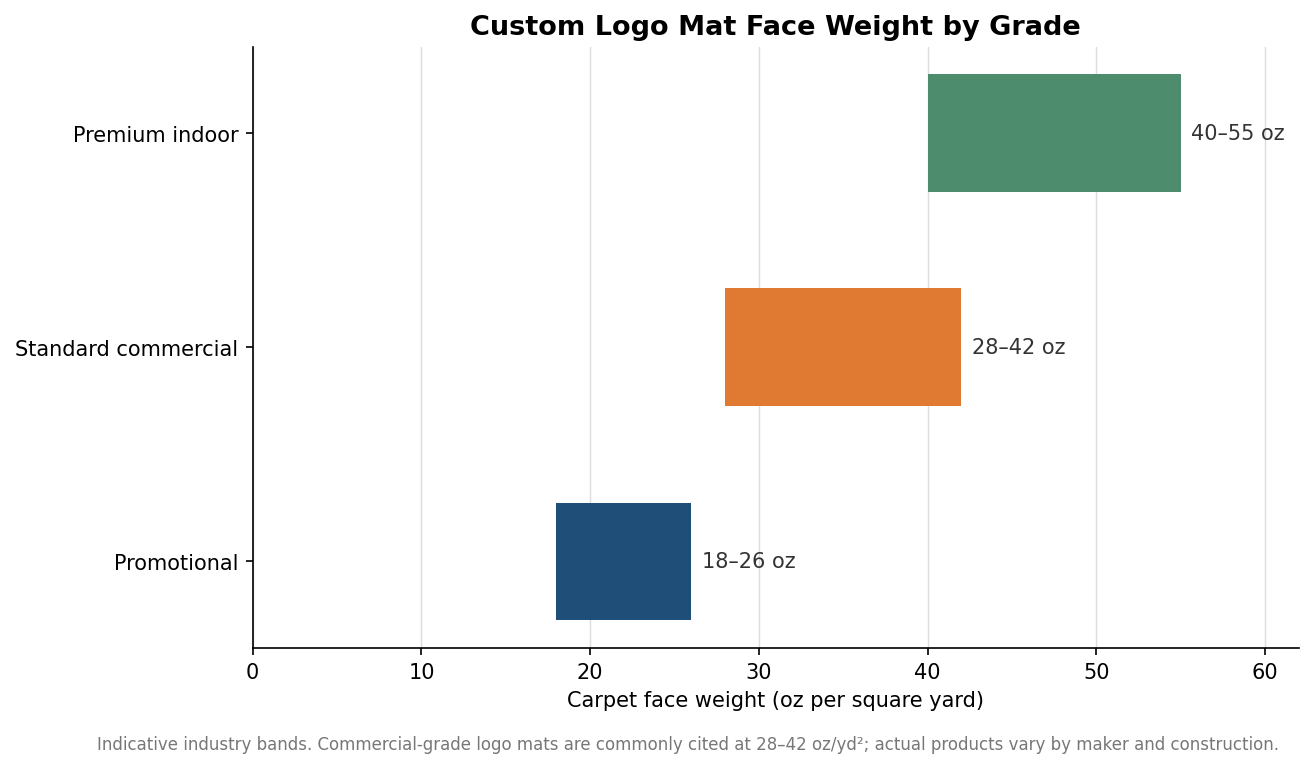
    Horizontal range chart of custom logo mat face weight in ounces per square yard by grade
    Indicative face-weight bands by mat grade; commercial logo mats commonly fall in the 28 to 42 oz range.

    Backings: nitrile, SBR and vinyl

    Nitrile rubber is the premium backing and the one to specify anywhere weather, oil, or grease is in play. It stays stable across a wide temperature range, roughly minus 40 to 226 degrees Fahrenheit, so it does not go brittle in a cold vestibule, and it resists oil, fuel, and chemicals that would degrade cheaper compounds. On quality mats it is typically 3/16 to 1/4 inch thick, which is part of why it lays flat and resists curling. SBR rubber is a serviceable entry-level backing: fine for protected indoor use, but with less resistance to cold and oil. PVC or vinyl backing is the lightest and cheapest, common on promotional mats, but it can stiffen and curl in the cold and will not stand up to grease the way nitrile does. If a mat will face the elements, the backing spec is not the place to save money.
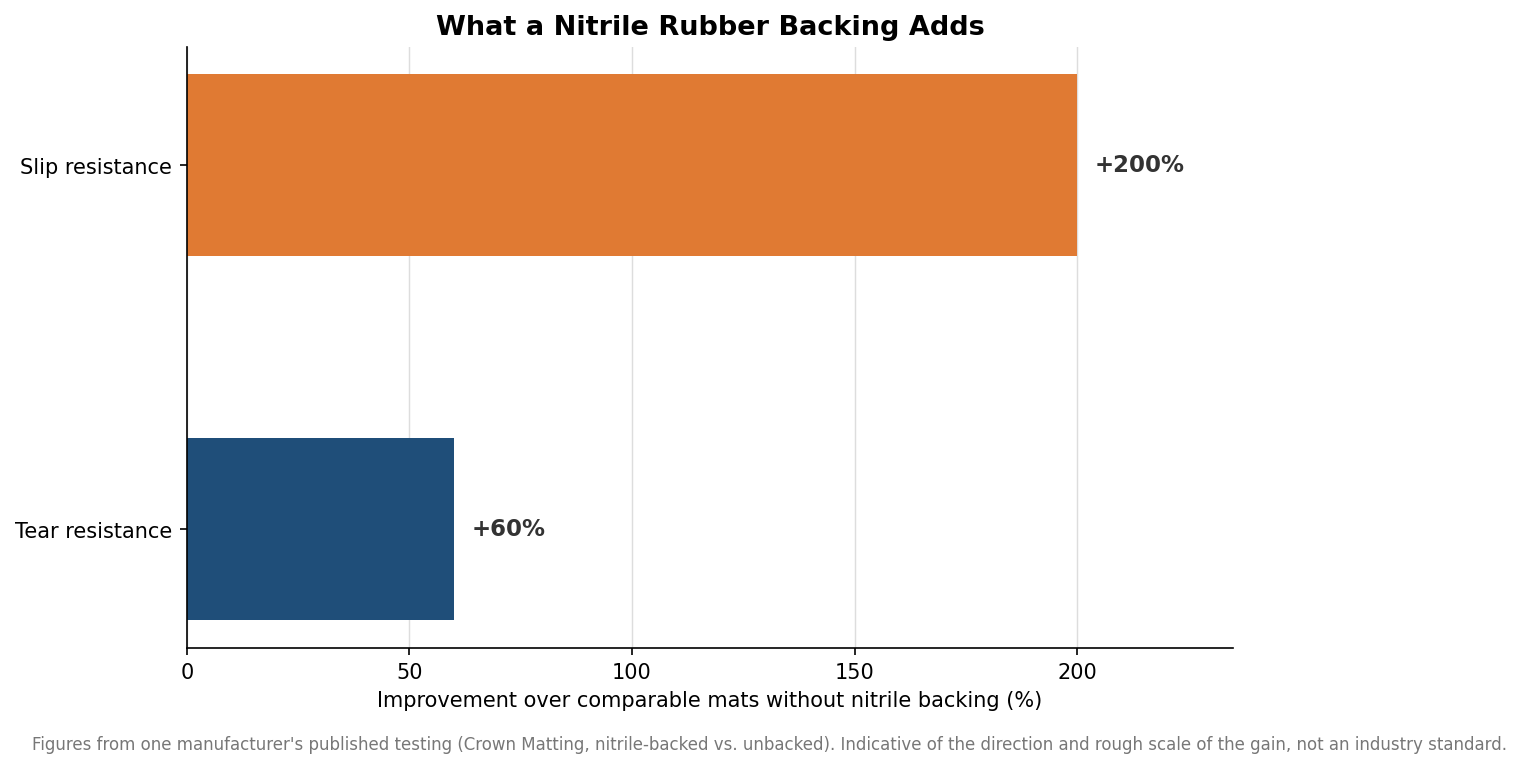
    Bar chart showing tear and slip resistance gains from nitrile rubber backing
    One maker’s published testing of nitrile-backed versus unbacked mats, shown as indicative direction and scale.

    Match the material to the placement

    The most reliable way to spend a matting budget is by zone rather than by buying one mat to do everything. Outside or in a covered entry, you want an aggressive scraper, a stiff polypropylene or a coir or textured-rubber mat, to knock grit and mud loose before it reaches the door. Just inside, you want an absorbent wiper, almost always nylon, to pull the remaining moisture off shoes. The branded logo mat itself does best as a nylon face on a nitrile backing, placed in the lobby where it is protected from the worst weather and seen by the most people. At registers and prep stations, a thicker molded rubber anti-fatigue mat is a different product again. A two-mat scraper-then-wiper system will outperform a single mat trying to do both jobs, and it protects your printed mat by keeping the abrasive grit away from it.

    What to confirm before you approve a proof

    Ask the supplier for four things in writing: face weight in ounces per square yard, the fiber type, the backing compound, and the backing thickness. Confirm how the logo is printed, since dye sublimation drives color into the fiber for a photographic, long-lasting result, while surface methods can wear differently. If the mat will see sun, ask specifically about colorfastness, and lean toward solution-dyed polypropylene for exterior placements. Standard footprints such as 3 by 5 feet, 4 by 6 feet, and 3 by 10 foot runners generally print more economically than odd custom cuts, so confirm the finished size early. Where a vendor quotes a service life, treat the number as indicative rather than a guarantee; real-world lifespan depends on traffic volume, how often the mat is cleaned, and whether a scraper mat is doing the hard work upstream. Nail down the material spec and the zone plan, and the mat that shows up will still look like your brand a long time after it ships.

  • How Custom Logo Rugs Are Made: Dye Sublimation vs Tufted

    There are two mainstream ways to get a logo into a commercial rug, and they are not variations on the same idea — they are genuinely different manufacturing processes with different strengths. One prints an image into fiber that already exists. The other builds the image out of colored yarn as the rug is made. Knowing which is which will tell you why one supplier says your gradient will look beautiful and another says it will come back as three flat blocks.

    Dye sublimation: printing into the fiber

    Sublimation starts with an undyed or light-colored synthetic face — usually polyester or nylon cut pile. The artwork is printed as a mirror image, then heat and pressure turn the solid dye directly into a gas, which penetrates the fiber and bonds inside it as it cools. Nothing is coated onto the surface. When you cut a sublimated fiber and look at the cross section, the color goes down into the strand.

    That single fact is what gives sublimation its two big advantages. First, resolution: because the process is essentially digital printing, it carries photographic gradients, watercolor texture, fine linework and small type without stair-stepping. A logo with a thin outline, a drop shadow or forty shades of one color costs the same as a logo with two colors, because there is no per-color setup at all. Second, wear: there is no printed layer sitting on top to scuff, flake or wash off, so the color survives vacuuming, hot-water extraction and commercial laundering.

    Its limits are real too. Sublimation needs a synthetic fiber — it will not bond into wool. Colors are laid onto a pale face, so very deep, saturated darks take more dye and can look slightly softer than the same color built from pre-dyed yarn. And the process suits shorter, denser pile: a very long, plush pile hides the detail you paid for.

    Tufted: building the image out of yarn

    Tufting works from the other direction. Needles punch pre-dyed yarn through a primary backing to form loops or cut pile, and the design is created by changing which color of yarn lands where. On a hand-tufted piece, a craftsperson works to a full-size drawing with a tufting gun; on machine-tufted goods, the pattern is driven by the machine. A secondary backing is then bonded on to lock the tufts in place, and the surface is sheared and carved to level it.

    Because the color arrives already in the yarn, tufted pieces give the most saturated, richest flat color you can get, and they can be built at almost any pile height, including deep plush that a printed rug cannot match. Carving around a shape adds physical relief, so a crest can sit slightly proud of the field. It is a beautiful process for a bold, simple mark on a plush surface.

    What it cannot do is detail. Every shape is resolved by where a needle can place a yarn, so fine type, hairline rules and photographic gradients get simplified into blocks. Each color is a separate yarn on the machine, so color count drives cost and lead time rather than being free. And a tufted piece is a heavier, more labor-intensive object to make.

    Which one lasts longer?

    This is the question buyers really want answered, and the honest answer is that the printing method is rarely what fails first. Two other things are.

    Colorfastness

    On colorfastness, sublimation and solution-dyed tufted yarn are close, and both beat anything surface-printed by a wide margin. Sublimated dye lives inside the strand; solution-dyed yarn has pigment added to the polymer before the fiber is even extruded, which is about as permanent as color gets. A west-facing lobby will shift either of them slightly across many years, but neither shows the streaky bleaching you get when color sits on the surface.

    Crush and abrasion

    On physical wear, the deciding factors are fiber type, face weight and twist — not print method. A dense, high-twist nylon in a printed entrance mat will outlast a loose, low-density tufted piece in the same doorway, and the reverse is equally true. Crush happens when concentrated traffic lands on a face that is too light for the door count, and it shows up as a flattened gray path long before any color has faded. When you compare quotes, compare the fiber and the face weight first, and treat the print method as a design decision.

    How to choose

    Send detailed logos, photographs, patterns, gradients and anything with small type to sublimation. Send bold, simple marks that need a deep plush hand, or a carved relief effect, to tufted. In practice, that means most entrance mats, printed area rugs, corridor runners and event floors are sublimated, and tufted work turns up where a room wants a heavier, more decorative piece.

    Preparing artwork for either process

    Vector files are ideal — AI, EPS, PDF or SVG — because they scale to room size without softening. A high-resolution raster file can work for sublimation if it was made large; anything pulled off a website will not be. If all you have is a photo of your sign, that is fine: our designers redraw the mark clean and print-ready at no charge.

    Two layout habits save the most disappointment. Scale the artwork to the finished piece and then look at it from across a room, because a mat is read from six feet up and never from a desk. And plan around the objects that will sit on it — a logo dead center is a logo under the coffee table, and a mark placed where the door swings is a mark nobody sees. We do both of these free on the mockup, and you get unlimited revisions before anything is committed.

    Send your artwork, sizes and quantity and we will come back within 24 hours with a scaled mockup, the recommended fiber and backing, and a quote. Minimum order is just 12 pieces, and standard delivery is 2 weeks.

  • Scraper, Wiper or Anti-Fatigue: Choosing the Right Entrance Mat System

    Almost every complaint a facilities manager hears about a lobby floor — the gray track worn down the middle, the caution cone that seems to live permanently by the door, the finish that had to be stripped a year early — starts at the threshold. Soil that gets past the entrance has to be removed from the building one square foot at a time, by hand, forever. The trade rule is blunt about it: the first stretch of floor inside a door decides how much dirt reaches everything beyond it. Getting the entry right is not a decorating decision, it is the cheapest maintenance program a building will ever run.

    Three jobs, three different mats

    Most of the confusion in buying comes from treating “entrance mat” as one product. It is three, doing genuinely different work, and the wrong one is worse than none because it looks like the problem is solved.

    Scraper mats: the outdoor stage

    A scraper mat lives outside the door, on the porch, sidewalk apron or dock. Its surface is stiff — monofilament polypropylene bristles or molded rubber ribs — and its whole purpose is to knock the heavy material loose before a sole crosses the threshold: mud, gravel, sand, ice melt crystals, wet grass clippings. Underneath, drainage channels carry water away so the mat is not sitting in a puddle it created. Sheer weight holds it down, which is what lets it survive wind, door swing and dolly traffic.

    Logos here have to be simplified. Fine linework and small type vanish into a bristle field, so the mark gets inlaid in colored rubber or set into a UV-stable insert, rebuilt as bold shapes that still read from the sidewalk.

    Wiper mats: the indoor stage

    The wiper mat sits just inside the door and does the opposite job. It is a dense, high-twist nylon pile on a cleated nitrile rubber backing, and it works by absorption and friction rather than abrasion: it pulls the remaining moisture and fine grit off the sole and holds it in the pile until somebody vacuums. Nylon is specified here for one reason above all others — resilience. It springs back after being stepped on, which is why a nylon wiper still looks like a mat after a winter while a cheaper fiber has packed into a flat gray path.

    This is also the mat that gets your logo, because it is the one every visitor looks at while they are still deciding what kind of building they have walked into.

    Anti-fatigue mats: not an entrance product at all

    An anti-fatigue mat is a closed-cell foam core under a printed wear layer, with a ramped edge on all four sides. It belongs where people stand still for hours — the register, the prep line, the teller window, the reception desk, the assembly bench. It does not scrape, it does not absorb, and its foam core is exactly what grit destroys fastest. Putting a cushioned mat inside a front door is one of the most common and most expensive specification mistakes we see.

    How much matting does a door actually need?

    The working rule in the industry is that a normal commercial entrance needs roughly twelve to fifteen feet of continuous matting across both stages to get a sole genuinely clean, and more in a wet climate. In practice that means a scraper outside and a longer wiper inside, running in the direction of travel rather than sideways.

    Width matters as much as length, and it is where most buyers under-order. A mat narrower than the clear opening leaves two strips of bare floor either side that take all the abuse the mat was meant to absorb. Measure the full clear width of the opening, not the door leaf. For a pair of doors, cover both leaves with one seamless piece rather than two mats with a seam down the middle where the traffic actually lands.

    The details that decide whether the spec works

    Backing

    Cleated nitrile rubber is the default on tile, terrazzo, stone and sealed concrete — the cleats bite in and the mat stays put. On finished hardwood or luxury vinyl plank, use a smooth rubber or vinyl backing instead, and lift the mat when the floor is mopped so nothing stays trapped underneath. On carpet, a felt-backed piece over a separate non-slip pad stops the mat creeping.

    Thickness and door clearance

    An indoor entrance mat sits around three eighths of an inch thick including the backing, and a cushioned mat is thicker still. If the door swings inward over the mat, measure the gap under the leaf at its mid point before you order and specify a low-clearance build. A dragging door is the fastest way to end up with an expensive mat rolled up in a storage closet.

    Edges

    Beveled ramp edges let luggage carts, wheelchairs and pallet jacks roll on and off without catching, and they keep the perimeter from curling. Printed rugs and runners get bound or serged edges for the same reason.

    A starting spec you can reuse

    For a typical main entrance: a bristled scraper mat outside the door with a simplified inlaid logo, a dense solution-dyed nylon wiper inside cut to the full clear opening with your full-detail mark, cleated nitrile backing on hard floors, beveled edges all round. Then the same spec, in different cut sizes, at every other door on the site. That is the part that pays off later — one approved artwork file and one written spec means the mat you order for the fourth building in three years arrives identical to the first.

    Rotate each mat end to end every quarter so the same eighteen inches of pile is not taking every footstep, vacuum in both directions, and extract or launder a few times a year. Send your door measurements and a logo file and we will lay the whole set out on a free mockup within 24 hours, from a minimum of just 12 pieces.

  • What a Branded Floor Mat Says About Your Lobby — and When to Replace It

    Walk into any building as a stranger and you form a judgment before anyone speaks to you. Most of that judgment comes from things nobody chose deliberately: whether the glass is clean, whether the air smells like the last tenant, whether the floor by the door is wet. The mat sits right in the middle of that moment. It is the only piece of branding in the building that every guest, every delivery driver, every inspector and every nervous interview candidate physically stands on, and in most buildings it is the one nobody owns.

    What a branded mat actually signals

    A clean, correctly sized mat with a crisp mark on it does not read as advertising. It reads as maintenance. It says the building has someone paying attention, which is exactly the thing a visitor cannot verify any other way in the first ten seconds. That is why a hotel crest at the threshold does more for a property’s perceived standard than the sign above the door, and why a dental practice with its own mark at the entrance reads as careful before a patient reaches the desk.

    The opposite signal is just as loud. A gray rental with a stranger’s faded logo in the corner, curling at one edge, sitting four inches short of the door frame with two worn strips of tile either side, tells a visitor something true about how the building is run — and it tells it every day, to everyone.

    The quiet second job

    The mat is also doing real work while it makes that impression. Everything it holds is soil that never reaches the rest of the floor, never gets ground into the finish, and never has to be scrubbed out one square foot at a time. In practice that moves cleaning labor off the entire floor plate and onto a vacuum pass at one door.

    A mat that has stopped performing is therefore more expensive than it looks. A packed-down, saturated mat has stopped absorbing, so the soil it used to hold is now traveling into the building on the sole of every shoe.

    The three ways mats fail

    The flattened path

    Concentrated traffic on a face that is too light for the door count packs the pile down into a permanent gray lane. Once the pile is crushed, it has lost the void space it needed to hold soil and water. This is a specification failure as often as an age failure: the mat was never dense enough for that door.

    The curling edge

    Edges lift when the perimeter takes repeated impact — a housekeeping cart, a suitcase wheel, a door sweep dragging — or when the backing has gone stiff with age and cold. A lifted edge is a trip hazard, and once it starts it does not go back on its own. Bound or serged edges on printed rugs, and beveled ramp edges on mats, exist to prevent exactly this.

    The unreadable mark

    The logo goes last, and it goes gradually enough that the people who walk past it daily stop noticing. The honest test is to stand up straight at normal walking distance, roughly six feet up, and see whether the mark still resolves. If you have to look for it, every visitor has already stopped seeing it.

    A five-minute audit

    Once a quarter, walk your entrances and answer five questions at each door. Does the mat cover the full clear width of the opening? Is there a visible flattened lane down the middle? Does any edge lift when you slide a foot along it? Is the logo legible standing up? And is the floor beyond the mat dry in wet weather, or is there a track running into the lobby?

    A yes to the last question usually means the entry is under-matted rather than worn out. The working rule in the trade is that a normal commercial entrance needs somewhere around twelve to fifteen feet of continuous matting across both stages — a scraper outside, a wiper inside — to genuinely clean a sole. Most buildings run a fraction of that and blame the mat.

    How often to rotate and replace

    Rotation is the cheapest life extension there is. Turn each mat end to end every quarter so the same eighteen inches of pile is not absorbing every single footstep, and once a year swap the front-door piece with one from a quieter side entrance. Vacuum slowly with a beater bar in both directions — the second pass in the opposite direction is what lifts grit out of the base of the pile, and grit at the base is what cuts fiber. Extract or launder a few times a year and let the piece dry fully before it goes back down.

    Done properly, a well-specified solution-dyed nylon entrance mat in a normal commercial doorway holds its look for several years. A door taking heavy traffic all day, or a full season of ice melt and grit, runs shorter. But the calendar is not the real trigger. The trigger is the audit: a permanent flattened path, an edge that will not lie down, or a mark you can no longer read. Any one of those means the mat stopped doing its job some time ago.

    Make replacement boring

    The reason mats get left too long is that reordering is usually a project — find the old artwork, re-measure the door, re-approve a proof. It does not have to be. When your approved artwork, colors, fiber, backing and cut sizes stay on file, a replacement is a two-line email and the piece that arrives is identical to the one it replaces. That is what turns entrance matting into a program you can run across a whole portfolio.

    Send your door measurements and a logo file and we will lay the set out on a free mockup within 24 hours, from a minimum of just 12 pieces, with delivery in 2 weeks.